Berlin 2026
I've heard from loved ones several times that I'd dig the vibe in Berlin. About how artsy and underground it was, similar to Montréal, but more gritty. Well, I finally booked the trip and went to see it in person.
What brought me to Berlin however, wasn't the artsy vibe alone. Inspired by an acquaintance in 2025, I started reading a lot about Cold War and the Soviet Union. I then shifted my attention to Germany and Berlin, and got to explore the oddness of what the country became after World War II. How it got turned into two countries, each initially controlled by the allies, and then the split into East and West, along with all the ideology differences that entails. I wanted to see how this split affected (and still affects to this day) the culture and architecture.
Accomodation
Without knowing much about the city's geography, I rented a studio apartment for 8 days in Prenzlauer Berg (east Berlin). I was at the Schonensche Strassße and Berliner Strassße intersection. This turned out to be a massive pro in my case, because this area was highly influential in the GDR times. Thanks to this wonderful resource, I discovered I was just a couple blocks from the border with West Berlin.
Even before checking into my apartment, I got to see tons of remarkable places within a 30min walk, such as the Bösebrücke bridge, which was the first border that was opened when the wall fell). The area is also very lively, with tons of amazing restaurants, coffee shops and public transport.
Highlights
I used ChatGPT to come up with an itinerary based on GDR-related tours and spots. I refined it a few times and organized it in a way that made it more convenient. These are some of the highlights:
Subways, Bunkers, Cold War Tour - with Berlin Untervelten
Amazing tour in the underground tunnels and bunkers of the city. As the very knowledgeable guide explained how the many bunkers were used during war times in cases of bombs, air raids and whatnot, it was really a shock to imagine what it must've been like to be the average person living in Berlin at the time, being at risk and having limited resources for them and their families. Also saw some escape routes to the West that were started after the Berlin Wall came up. I highly recommend Berlin Untervelten tours and will come back for more the next time I'm in Berlin. More info here. No photos allowed.
Tempelhof Airport
I learned the word for airport in German is flughafen. This airport was built by the nazis and its overwhelming architecture was meant to portray Berlin as the center of the world. It was decommissioned in 2008 due to its proximity to the city center and its layout, which was not the most convenient compared to more modern airports. Tempelhof was how the American military would access the city during the Berlin airlift. The airport seems to be frozen in time, with much of its decoration and layout dating from when it was most used in WWII and the 70s. It even had a sports court used mostly by the US military back then. Worth the visit.
Bernauer Straße Wall Memorial
This was a very emotional stop, as this street was cut over by the Berlin Wall back in the day. You can see pictures of people who died trying to escape East Berlin, as well as how some of the houses split by the wall had its doors and windows bricked up. To think the place where the memorial stands used to be a death strip is mind blowing. Lots of old pictures and info to read along the wall remains. Mandatory spots for those interested in Cold War.
Karl-Marx-Allee
Monumental, socialistic and kinda empty. I visited this street on my last full day in Berlin. Another must-see if you're there for Cold War sightseeing. I wanted to see Kino International, and despite not watching any movies there, it was cool to enter the building and see the architecture all around it. They also have free, renovated bathrooms, which is a luxury if you've travelled in Europe. Around the area you can also see multiple plattenbaus that have mostly been renovated, but still sported some fixtures from when they were built. There's also lots of old socialist-style panels that were left untouched. Cool stuff, just don't go there looking for nice restaurants or even a coffee shop cause you won't find it. The street is somewhat dead.
East Side Gallery
I went there right after Karl-Marx-Allee. This is a classic stop for history lovers and was so much nicer than anything I could've hoped for. There's a never-ending stretch of the wall that was turned into an outdoor art gallery for artists all over the world (Brazil and Quebec also featured!). It also overlooks die Spree, a river that was part of the east/west separation of the city. Many of the art pieces feature freedom and peace messages, and it was inspiring to see. Really cool spot overall with lots of things to see within a 20 minute walk.
Urban Spree
The final spot I hit on my last day in Berlin. I walked A WHOLE LOT that day. I was on a quest to eat crepe. Had walked for half an hour to get to a specific place not far from the East Side Gallery, but got distracted with all Berlin has to offer and got there about 5 minutes before 6pm, when this place would close. So I decided to put another crepe spot on maps while telling myself "I'll stay for a crepe, some coffee, people watching and head home" to catch an early morning flight the next day. Oh man I was so wrong. At this second crepe spot that looked like a trailer park, I can finally eat tranquille outside and people watch, but an enticing house music coming somewhere from the back catches my attention. I decide to follow my good time instincts against my need to get enough sleep and end up at this AMAZING biergarten that also featured an urban architecture art gallery, a ping-pong table, a DJ mixing vinyls of incredible taste and a venue. I got a beer and had a great time vibing to the music. I worked around my shyness to talk to a group of German men and ask to play ping-pong with them. Had a great time there as well. When I decided it was time to leave and get some sleep, I go to the bathroom one last time and lo and behold, I hear goth music coming from out of the venue next to the bathroom. Long story short, there would be a goth event that night, and I obviously stayed until late in the morning. I met so many great artists that day, many of whom happened to be Brazilian! Also befriended one of the DJs of the night, who was from Uruguay and vibed with me during the first set. I'll link them all here, go check them out:
I ended the night with a vegan dönner near the venue and took the train back to my studio. It felt so right. Thank you Berlin: it was a blast and I can't wait to be back!
Gallery
Building by Karl-Marx-Allee with its original fixtures
Kino International movie theater
East Side Gallery
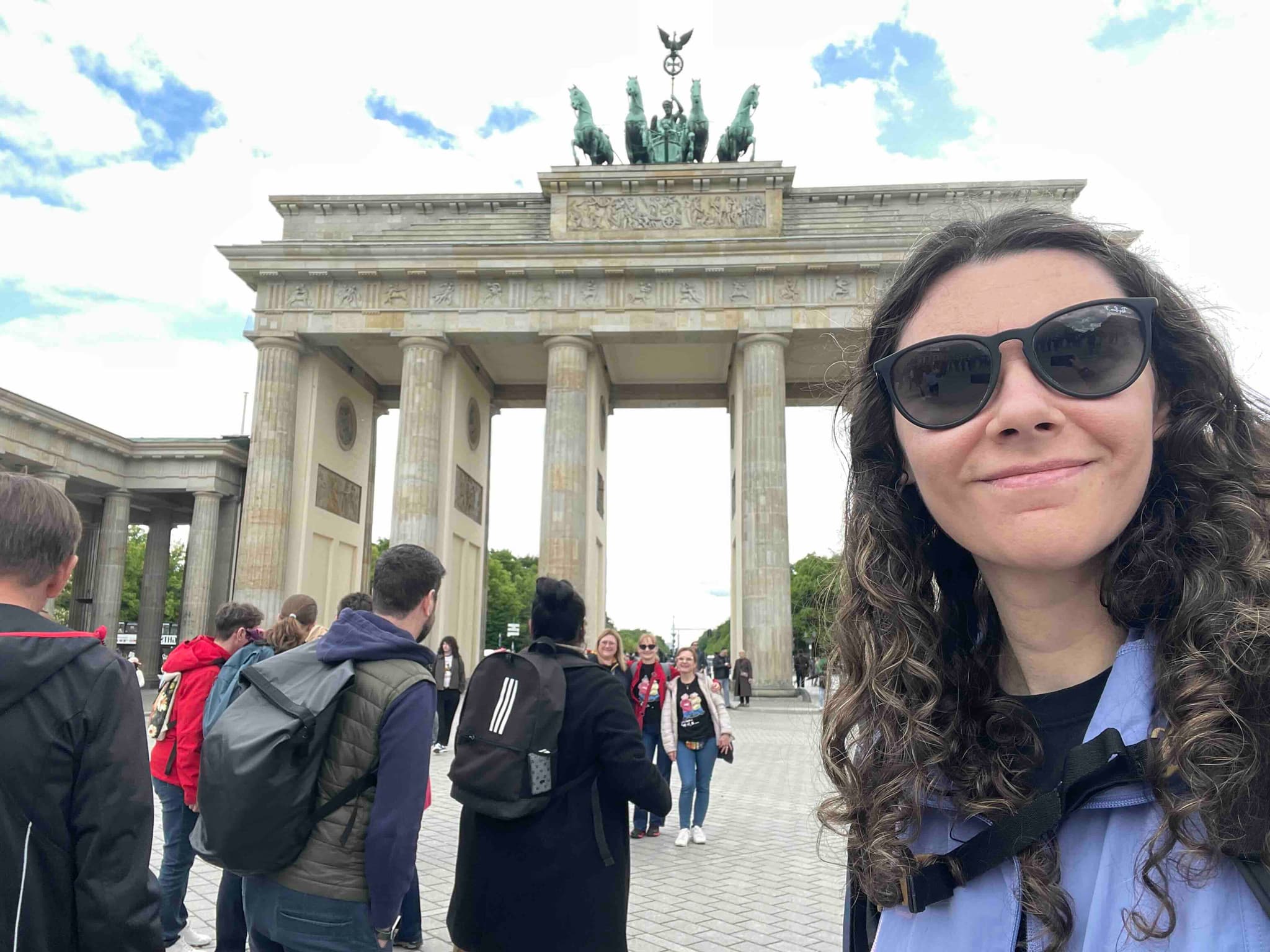
Somewhere in Berlin
Soviet Union memorial
Alexanderplatz GDR World Clock featuring São Paulo and Montreal
World War II bunker
Lua, aka Vampira Gotica
I freaking love watching train tracks